
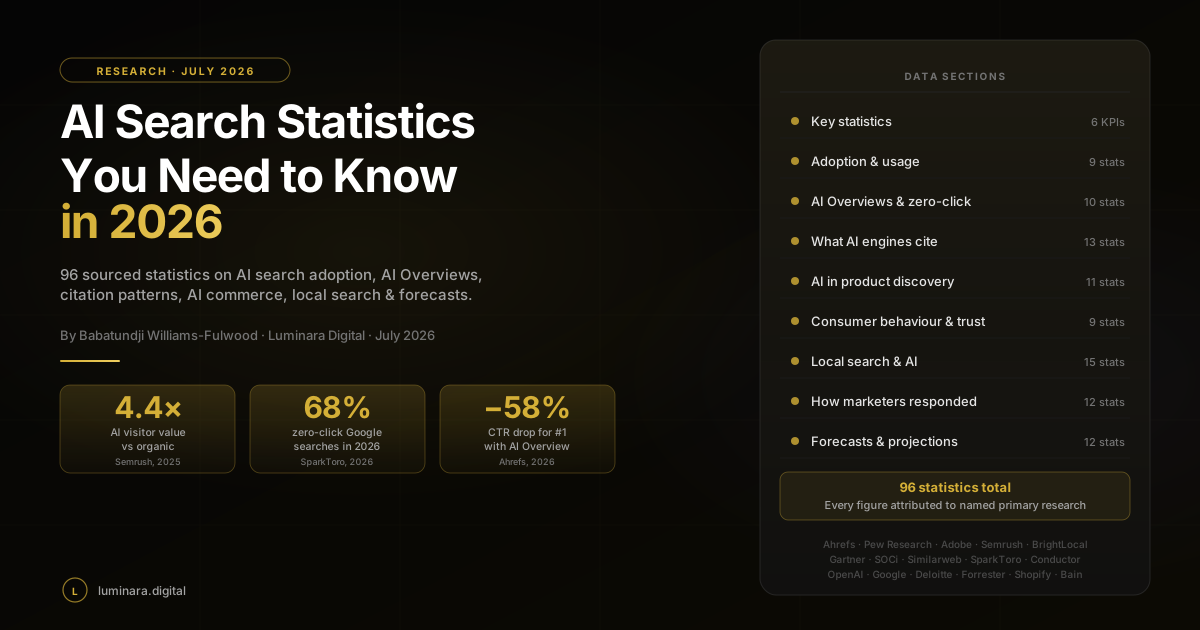
4.4×
value of an AI search visitor vs traditional organic - measured by conversion rate (Semrush, 2025)
68.01%
of Google searches ended without a click in 2026, up from 60.45% in 2024 (SparkToro / Similarweb)
1,324%
growth in AI-referred traffic to US retail sites between October 2024 and May 2026 (Adobe Analytics)
01 - Key AI search statistics
The numbers most likely to be quoted in 2026, in one place.
900M+
ChatGPT weekly active users
OpenAI, Feb 2026
49%
of U.S. adults use AI chatbots
Pew Research Center, 2026
68.01%
of Google searches end without a click
SparkToro / Similarweb, 2026
−58%
CTR for the #1 result when an AI Overview appears
Ahrefs, 2026
4.4×
value of an AI search visitor vs organic
Semrush, 2025
1,324%
growth in AI traffic to U.S. retail sites
Adobe, Oct 2024–May 2026
ChatGPT has more than 900 million weekly active users, the first time OpenAI publicly cited that mark, alongside more than 50 million consumer subscribers and more than 9 million paying business users.
Source: OpenAI, reported by Search Engine Land, February 2026
Google's Gemini app surpassed 900 million monthly active users, up from 400 million a year earlier, with daily requests expanding more than sevenfold.
Source: Google, Sundar Pichai I/O keynote, 2026
Google's AI Mode surpassed 1 billion monthly users, with AI Mode queries more than doubling every quarter since launch.
Source: Google I/O announcements, 2026
Searching for information is the single most common use of AI chatbots, cited by 42% of U.S. adults - ahead of work tasks (38% of employed adults), entertainment (25%) and image or video creation (24%).
Source: Pew Research Center, February 2026
The average AI search visitor is 4.4 times as valuable as the average traditional organic search visit, measured by conversion rate.
Source: Semrush, 2025
02 - AI search adoption & usage
How many people actually use AI to find things - and how fast that changed.
49%
of U.S. adults now use AI chatbots, up from 33% in 2024. (Source: Pew Research Center, survey of 5,119 U.S. adults, February 17–23, 2026)
The share of Americans who use ChatGPT has more than doubled since 2023, from 18% to 44%. Gemini is used by 24%, Copilot by 17% and Meta AI by 14%.
Source: Pew Research Center, 2026
Roughly one-quarter of Americans use AI chatbots daily, including 12% who do so several times a day and 4% who use them almost constantly.
Source: Pew Research Center, 2026
60% of Americans say they read the AI-generated summaries at the top of search results, while 30% say they do not and 10% are unsure.
Source: Pew Research Center, 2026
Adults under 50 are about twice as likely as those 50 and older to use ChatGPT - 57% versus 28%.
Source: Pew Research Center, 2026
Visits to generative AI platforms reached toward 1.5 billion monthly as of January 2026.
Source: Similarweb, January 2026
Monthly referrals from generative AI platforms to websites climbed from roughly 60 million in October 2024 to around 240 million by September 2025, then held flat between 240 and 280 million through January 2026.
Source: Similarweb, 2026
Between September 2024 and March 2026, ChatGPT's web visits grew 84%, Gemini grew roughly ninefold on web, and Claude's web traffic rose roughly 770%.
Source: Similarweb, 2026
Users arriving from ChatGPT spent 15 minutes on site versus 8 minutes for Google referrals, viewed 12 pages versus 9, and converted on transactional sites at 7% versus 5%.
Source: Similarweb, 2026
Only about one-in-ten U.S. adults get news from AI chatbots often (2%) or sometimes (7%), while 75% say they never do.
Source: Pew Research Center, survey of 5,153 U.S. adults, August 2025
03 - AI Overviews & the zero-click shift
What happens to clicks when an AI answer sits above the results.
8% vs 15%
Google users clicked a traditional search result in 8% of visits where an AI summary appeared - versus 15% of visits where none did. Users clicked a link inside the AI summary in just 1% of visits. (Source: Pew Research Center, 68,879 searches by 900 U.S. adults, March 2025)
The presence of an AI Overview correlates with a 58% lower average click-through rate for the top-ranking page, up from 34.5% eight months earlier. Position 2 loses 50.8%, position 3 loses 46.4%, position 5 loses 32.6%, position 10 loses 19.4%.
Source: Ahrefs, 300,000 keywords, February 2026
68.01% of Google searches ended without a click in the first four months of 2026, up 7.56 percentage points from 60.45% in 2024.
Source: SparkToro, using Similarweb US desktop and mobile panel data, 2026
Users ended their browsing session entirely after 26% of visits to a results page with an AI summary, versus 16% of visits to pages without one.
Source: Pew Research Center, 2025
18% of all Google searches in Pew's study generated an AI summary - 12,593 of 68,879 unique searches - and 58% of respondents ran at least one search producing one.
Source: Pew Research Center, March 2025
60% of queries beginning with question words produced an AI summary, as did 53% of searches of 10 words or more, but just 8% of one- or two-word searches.
Source: Pew Research Center, 2025
AI Overviews triggered on 6.49% of queries in January 2025, peaked at 24.61% in July 2025, then settled at 15.69% in November 2025, across more than 10 million keywords.
Source: Semrush, 2025
Commercial queries triggering AI Overviews rose from 8.15% to 18.57% between October 2024 and October 2025; transactional queries rose from 1.98% to 13.94% and navigational from 0.84% to 10.33%.
Source: Semrush, 2025
Google search traffic to publishers declined globally by a third in the year to November 2025, with Google Discover referrals down 21% and US organic search referrals down 38% year on year.
Source: Chartbeat, published in the Reuters Institute Trends and Predictions 2026 report
Across 19 Digital Content Next member companies, the median year-over-year decline in Google referral traffic was 10% - 7% for news brands and 14% for non-news brands.
Source: Digital Content Next, May–June 2025
News industry respondents expect traffic to decline 43% on average over the next three years, with roughly one-fifth anticipating losses exceeding 75%.
Source: Reuters Institute for the Study of Journalism, 2026
User behaviour on a Google results page: with vs without AI summary
Clicked a traditional search result
- With AI Summary
- 8%
- Without AI Summary
- 15%
Ended browsing session entirely
- With AI Summary
- 26%
- Without AI Summary
- 16%
Clicked a link inside the AI summary
- With AI Summary
- 1%
- Without AI Summary
- n/a
04 - What AI engines actually cite
The most practically useful section, and the one where the received wisdom holds up worst.
3×
Branded web mentions correlate with AI brand visibility roughly three times more strongly than backlink counts - 0.656–0.709 versus 0.194–0.240 across ChatGPT, Google AI Mode and AI Overviews. (Source: Ahrefs, study of 75,000 brands, December 2025)
YouTube mentions were the single strongest correlate of AI brand visibility, at approximately 0.737 across all three platforms - higher than Domain Rating (0.266–0.326) or any link metric.
Source: Ahrefs, 2025
Only 38% of pages cited in Google AI Overviews also rank in the organic top 10, down from approximately 76% in July 2025.
Source: Ahrefs, 863,000 keyword SERPs and 4 million AI Overview URLs, March 2026
YouTube accounts for 18.2% of non-ranking AI Overview citations and is the most-cited domain overall in AI Overviews, growing 34% over six months.
Source: Ahrefs, 2026
Adding JSON-LD schema changed citations by −4.6% in Google AI Overviews, +2.4% in AI Mode and +2.2% in ChatGPT - only the AI Overviews decline was statistically significant - across 1,885 pages measured against 4,000 controls.
Source: Ahrefs, August 2025–March 2026
53% of AI-cited pages use schema markup, but Ahrefs attributes this to correlation with overall site quality rather than schema causing citations.
Source: Ahrefs, 2026
44% of AI Overview citations came from outside the top 20 organic results, with 32% from positions 1–3 and 27% from positions 11–20.
Source: seoClarity, 5.1 million citations across 362,000 US desktop queries, October 2025
ChatGPT cites an average of 15 sources per response while Gemini cites an average of 3.
Source: Semrush 2026 AI Visibility Index, 126 million US prompts, January–April 2026
On Gemini, the overlap between brands mentioned in an answer and the domains actually cited as sources can be as low as 30% - being named is not the same as being cited.
Source: Semrush, 2026
Google AI Mode citations overlapped with the organic top 10 at roughly 54% by domain and 35% by URL, versus roughly 86% domain overlap for AI Overviews and 91%+ for Perplexity.
Source: Semrush, 5,000 keywords and 150,000+ citations, July 2025
Wikipedia was ChatGPT's single largest source at 7.8% of citations, while Reddit led Perplexity at 6.6% and Google AI Overviews at 2.2%, across 680 million logged citations.
Source: Profound, August 2024–June 2025
Commercial .com domains made up 80.41% of all AI citations analysed, followed by .org at 11.29%.
Source: Profound, 2025
ChatGPT cited Reddit in close to 60% of prompt responses in early August 2025, before that share collapsed to around 10% by mid-September 2025. Wikipedia's share fell from roughly 55% to under 20% over the same period.
Source: Semrush, 230,000 prompts and 100 million citations, July–October 2025
Google AI Mode responses averaged approximately 300 words, with commercial and transactional responses running about twice as long as informational ones; 92% of AI Mode queries featured a sidebar averaging around 7 unique domains, versus 3 in AI Overviews.
Source: Semrush, 2025
05 - AI in product discovery & e-commerce
Where AI search stopped being an information channel and became a buying channel.
1,324%
Growth in AI-referred traffic to U.S. retail sites between October 2024 and May 2026. Travel sites rose 2,215% over the same period. (Source: Adobe Analytics, June 2026)
AI-referred traffic to U.S. retail sites grew 138% year over year in May 2026, and converted at a rate 54% better than non-AI sources, based on more than 1 trillion visits.
Source: Adobe Analytics, 2026
Consumers arriving from AI referrals spent 53% more time on retail sites and browsed 23% more pages per visit, and were 15% more engaged than non-AI traffic.
Source: Adobe Analytics, May 2026
Generative AI drove a 693.4% increase in traffic to U.S. retail sites over the 2025 holiday season, and AI traffic to retail sites rose 670% on Cyber Monday.
Source: Adobe Analytics, November 1–December 31, 2025
AI-driven traffic to Shopify stores grew eightfold year over year in Q1 2026, and orders from AI-powered searches increased nearly thirteenfold, with new buyer orders from AI searches occurring at nearly twice the rate of traditional organic search.
Source: Shopify Q1 2026 earnings call
Shopify has structured more than 1 billion products with clean attributes, real-time pricing and accurate inventory to make its merchant catalogue readable by AI agents.
Source: Shopify Q1 2026 earnings call
More than 250 million customers used Amazon's Rufus AI shopping assistant over the year, with monthly average users up 149% and interactions up 210%; customers who use it are over 60% more likely to purchase during that shopping trip.
Source: Amazon, 2026
US e-commerce sales via AI platforms will exceed $20 billion in 2026 and top $144 billion by 2029, counting third-party AI platforms but excluding retailer-native tools.
Source: EMARKETER, 2026
61% of B2C organisations plan to implement agentic AI within the next 12 months, per a survey of 1,100 senior decision makers across five markets.
Source: Algolia 6th Annual eCommerce Search Report, November 2025
83% of B2B sellers now prioritise AI when selecting search tools, and 71% are already using AI in e-commerce operations, up from 67% in 2025.
Source: Algolia B2B Ecommerce Site Search Trends Report, 2026
62% of consumers say they are more likely to make purchases with generative AI-driven guidance, rising to 68% among millennials.
Source: Coveo, survey of 4,000 US and UK consumers, 2025
39% of shoppers surveyed have used generative AI for online shopping, 92% of them said it enhanced their experience, and 87% said they are more likely to use AI for larger or more complex purchases.
Source: Adobe, survey of 5,000+ respondents, 2025
06 - Consumer behaviour & trust in AI search
Usage is climbing. Trust is not climbing with it.
82% → 54%
The share of consumers saying AI-powered search is more helpful than traditional search fell from 82% in 2025 to 54% in 2026, while self-described AI skeptics grew from 3% to 17% - even as 70% say they use AI search tools more than last year. (Source: Fractl, survey of 1,008 US consumers and 150 marketers, Q2 2026)
54% of consumers said they had to double-check the accuracy of all information generative AI tools provided, and 62% said information from those tools ended up being a waste of their time.
Source: Gartner, survey of 846 U.S. consumers, November–December 2025
72% of consumers said generative AI appears in their internet and app use whether they asked for it or not.
Source: Gartner, 2026
74% of AI users rate their trust in AI recommendations at 4 or 5 out of 5, yet more than 93% still take at least one verification step - 62% immediately search Google, 58% visit the business's website directly and 52% click through to cited sources.
Source: Yext Consumer Search Behaviors Report, 2026
30% to 45% of US consumers use generative AI for product research and comparison, yet around half remain cautious about letting AI agents autonomously handle purchases end to end.
Source: Bain & Company Consumer Lab, 2025
Consumers trust retailers' own on-site AI agents three times more than third-party agents.
Source: Bain & Company, 2025
Willingness to let AI narrow choices reached 31% for household supplies and 28% for personal electronics, but willingness to let AI make the actual purchase decision topped out at 11%.
Source: Gartner, survey of 322 U.S. consumers, January 2026
17% of online shoppers said they would begin holiday shopping with an AI platform, versus 30% starting with Google search; among millennials that rose to 52%.
Source: Bain & Company, November 2025
76% of shoppers want to set boundaries for AI assistants, two-thirds trust AI more when it explains its reasoning, and 71% are worried about how generative AI uses personal information.
Source: Capgemini Research Institute, 12,000 consumers across 12 countries, 2026
One in four consumers used generative AI shopping tools in 2025 and a further 31% plan to adopt them, though only 19% would pay for a chatbot or virtual shopping assistant subscription.
Source: Capgemini Research Institute, 2026
07 - Local search & AI assistants
The category where AI adoption moved fastest and AI visibility remains hardest to win.
6% → 45%
The share of consumers using AI tools such as ChatGPT for local business recommendations rose from 6% in 2025 to 45% in 2026. (Source: BrightLocal Local Consumer Review Survey, 1,002 US adults, 2026)
Only 1.2% of locations were recommended by ChatGPT, 11% by Gemini and 7.4% by Perplexity - against 35.9% appearing in Google's local 3-pack.
Source: SOCi Local Visibility Index, nearly 350,000 locations across 2,751 multi-location brands, 2026
SOCi estimates AI local visibility is three to 30 times harder to achieve than ranking well in traditional local search.
Source: SOCi, 2026
Business profile information surfaced by AI assistants was only about 68% accurate on ChatGPT and Perplexity, versus 100% on Gemini, which is grounded in Google Maps.
Source: SOCi, 2026
Locations recommended by ChatGPT averaged 4.3-star ratings, versus 4.1 for Perplexity and 3.9 for Gemini - making consumer sentiment one of the strongest influences on AI local recommendations.
Source: SOCi, 2026
In retail, only 45% of the top 20 brands by traditional local search visibility also appeared in the top 20 most recommended by AI.
Source: SOCi, 2026
31% of consumers used ChatGPT and 23% used Google's AI Mode for local business recommendations.
Source: BrightLocal, 2026
63% of active AI users trust AI recommendations for local businesses and 42% of all consumers trust AI as much as traditional reviews - but 88% still verify, checking legitimacy (51%) or sources (37%).
Source: BrightLocal, 2026
ChatGPT Search drew 58% of its local sources from business websites, 27% from business mentions and 15% from online directories, across 800 manual local queries in 20 US cities and 20 verticals.
Source: BrightLocal, November 2024
Wikipedia accounted for 39% of all business-mention sources in ChatGPT Search local results, while Yelp, Facebook and Google Maps did not appear as directory sources at all.
Source: BrightLocal, 2024
Google's share of consumers reading local business reviews fell to 71% in 2026, down from 83% in 2025, while ChatGPT and other AI tools rose to 45% and Apple Maps to 27%.
Source: BrightLocal, 2026
82% of consumers read AI-generated review summaries and 23% rely solely on those summaries when making a decision about a local business.
Source: BrightLocal, 2026
31% of consumers now require a minimum 4.5-star rating before using a local business, up from 17% in 2025, and 68% require at least 4 stars, up from 55%.
Source: BrightLocal, 2026
97% of consumers read reviews for local businesses, and 41% now always read reviews when browsing, up from 29% in 2025.
Source: BrightLocal, 2026
46% of consumers always or often add "near me" to their local search queries, and 85% consider contact information and opening hours an important factor when researching local businesses.
Source: BrightLocal Consumer Search Behavior, 2025
13.49% of Google AI Mode queries included a local pack in an analysis of 5,000 keywords.
Source: Semrush, 2025
08 - How marketers are responding
Enterprise budgets moved early. The broader market did not.
Share of digital budget to AEO/GEO
- Enterprise sample
- 12% average
- Broad market sample
- 9% vs 24% for SEO
Investment posture
- Enterprise sample
- 56% significant/high investment
- Broad market sample
- 63% not investing at all
Understanding of the discipline
- Enterprise sample
- 73% advanced or very advanced
- Broad market sample
- 33% good or expert
97% of enterprise digital leaders reported a positive impact from AEO in 2025, and 94% plan to increase AEO investment in 2026.
Source: Conductor State of AEO/GEO report, 2026
Organisations allocated an average of 12% of digital marketing budgets to AEO/GEO in 2025, with 56% making a significant or high investment.
Source: Conductor, 2026; corroborated by EMARKETER, 2026
63% of US marketers said their company is not investing time, budget or staff in GEO, with just 9% of marketing resources allocated to GEO versus 24% for SEO.
Source: Centerfield Gen-AI Search Readiness Survey, 878 US marketers, September 2025
93% of marketers said they face barriers to GEO implementation, with 40% citing budget and 36% citing limited expertise or competing priorities.
Source: Centerfield, 2025
Only 33% of marketers said they have a good or expert understanding of GEO, compared with 72% for SEO.
Source: Centerfield, 2025
45% of marketing leaders cannot accurately measure their brand's visibility in AI-generated answers, and only 9% have tools to track all relevant metrics across platforms.
Source: Semrush 2026 AI Visibility Index
81% of organisations that fully integrate SEO and AI visibility into one workflow reported increased traffic or leads from AI platforms - versus 36% of those managing them separately.
Source: Semrush, 2026
Only 14% of marketers track AI search citations, even though 89% of brands already appear in AI-powered search results.
Source: GoodFirms, survey of 100 practitioners, January–February 2026
65% of marketers identify AI-driven search changes as their top challenge, while 43% list AI/LLM optimisation as a strategic priority.
Source: GoodFirms, 2026
75% of senior SEOs said the existing SEO team owns AI search efforts, with few dedicated teams created, even though 91% said leadership had requested an AI search visibility assessment in the past year.
Source: SEOFOMO State of AI Search Optimization Survey, 200+ senior SEOs, 2025
62% of SEOs reported that AI search drives less than 5% of their company's revenue.
Source: SEOFOMO, 2025
The industry cannot agree what to call the discipline: 36% say "AI search optimization", 27% simply call it SEO for AI platforms, and 18% use "generative engine optimization (GEO)".
Source: SEOFOMO, 2025
09 - Forecasts & projections
What the analyst houses expect next - presented as forecasts, not facts.
Gartner forecasts that by 2028, many brands will see organic search site traffic decrease by 50% or more as consumers embrace generative AI-powered search.
Source: Gartner, February 2024
Gartner predicted traditional search engine volume would drop 25% by 2026, with search marketing losing share to AI chatbots and virtual agents.
Source: Gartner, February 2024
Semrush forecasts AI search visitors will surpass traditional search visitors in 2028 for digital marketing and SEO topics, noting it could happen sooner if Google Search becomes AI Mode by default.
Source: Semrush, 2025
Semrush projects AI channels will drive similar global economic value to traditional search by the end of 2027.
Source: Semrush, 2025
Deloitte predicts about 29% of adults will initiate one or more searches daily with a generative AI summary in 2026, rising to 40% in 2027 - versus 13% using any standalone generative AI app daily.
Source: Deloitte TMT Predictions 2026, November 2025
Deloitte predicts that by mid-2026 more adults will have generated a search overview (72%) than will have used a standalone generative AI tool at any time (61%).
Source: Deloitte, 2025
Forrester predicts leading advertisers will cut display ad budgets by 30% in 2026 as AI summaries and chat interfaces shrink addressable audiences on the open web.
Source: Forrester 2026 B2C Marketing, CX & Digital Predictions, October 2025
Forrester predicts a third of companies will harm customer experiences with frustrating AI self-service in 2026 as cost pressure pushes premature chatbot deployment.
Source: Forrester, 2025
BrightEdge reports AI agent requests have reached 88% of human organic search activity and projects AI agent activity will surpass human-driven search by the end of 2026.
Source: BrightEdge, April 2026
AI referral traffic accounts for 1.08% of all website traffic, growing at approximately 1% month over month, across 1,215 enterprise domains and 3.3 billion sessions.
Source: Conductor AEO/GEO Benchmarks, May–September 2025
The global GEO services market is projected to grow from $886 million in 2024 to $7.32 billion by 2031, a CAGR of 34.0%.
Source: Valuates Reports, July 2025
The global SEO services market is estimated at $83.98 billion in 2026, forecast to reach $148.86 billion by 2031 at a 12.12% CAGR, with voice and visual search SEO the fastest-growing segment at 20.10%.
Source: Mordor Intelligence, 2026
10 - Methodology & citation policy
Every statistic on this page was taken from a source page that was retrieved and read directly, not from a search-result snippet or a secondary statistics roundup. Each entry carries the name of the organisation that produced the research and the year the data was collected or published.
Figures were quoted as published, without rounding or extrapolation. Where a widely circulated number could not be traced to a retrievable primary source, it was excluded rather than repeated. Where two credible sources disagree, both are shown with their attributions and dates.
Several sources measure related but non-identical things: platform-reported user counts differ from panel-measured behaviour, domain-level citation overlap differs from URL-level overlap, and enterprise survey samples differ markedly from broad-market ones. Those distinctions are noted where they materially affect interpretation.
Source organisations: Adobe Analytics · Ahrefs · Algolia · Amazon · Bain & Company · BrightEdge · BrightLocal · Capgemini Research Institute · Centerfield · Chartbeat · Conductor · Coveo · Deloitte · Digital Content Next · EMARKETER · Forrester · Fractl · Gartner · GoodFirms · Google · Mordor Intelligence · OpenAI · Pew Research Center · Profound · Reuters Institute · Search Engine Land · Semrush · seoClarity · SEOFOMO · Shopify · Similarweb · SOCi · SparkToro · Valuates Reports · Yext
Conclusion
The picture that emerges from 96 primary-source statistics is not that AI is replacing search - it is that AI is restructuring the economics of search. ChatGPT and Gemini are enormous platforms, but they send a fraction of the clicks that Google's local pack still delivers. The average AI visitor is worth 4.4× more than an organic visitor, but AI referrals make up just 1.08% of website traffic. Clicks per search are collapsing, but search volume itself has not fallen the 25% Gartner forecast for 2026. The businesses that will win are those that understand both sides of this: capture AI citations through branded mentions, YouTube presence and authoritative content - while keeping Google organic and Maps working hard, because that is still where most of the volume flows. At Luminara Digital, that dual-channel approach is what we build for Australian DTC, wellness and clinic brands. Our free visibility check reads your homepage, robots.txt and llms.txt and shows what AI crawlers and search engines can see. For a full review of search and AI visibility, see the AI + SEO Foundation Audit on our pricing page.
Common questions
About half of U.S. adults (49%) now use AI chatbots, up from 33% in 2024, according to Pew Research Center. ChatGPT reported more than 900 million weekly active users in February 2026, and Google reported that the Gemini app passed 900 million monthly active users while AI Mode surpassed 1 billion monthly users.
Yes. Pew Research Center found users clicked a traditional search result in 8% of visits where an AI summary appeared, versus 15% where none appeared. Ahrefs measured a 58% lower average click-through rate for the top-ranking page when an AI Overview is present, with losses at every position down to −19.4% at position 10.
Ahrefs found branded web mentions correlate with AI brand visibility at 0.656 to 0.709 - roughly three times stronger than backlink counts at 0.194 to 0.240 - with YouTube mentions the single strongest correlate at approximately 0.737. Ahrefs also found only 38% of pages cited in Google AI Overviews rank in the organic top 10, down from about 76% in July 2025.
The direct evidence is weaker than commonly claimed. Ahrefs tracked 1,885 pages that added JSON-LD schema against 4,000 control pages and found citations changed by −4.6% in Google AI Overviews, +2.4% in AI Mode and +2.2% in ChatGPT, with only the AI Overviews decline being statistically significant. 53% of AI-cited pages use schema, but Ahrefs attributes this to correlation with overall site quality.
By conversion rate, yes. Semrush found the average AI search visitor is 4.4 times as valuable as the average traditional organic search visit. Adobe Analytics found AI-referred traffic to U.S. retail sites converted at a rate 54% better than non-AI sources in May 2026 - a reversal from March 2025, when Adobe measured AI traffic converting 9% worse. Volume remains small: Conductor benchmarked AI referrals at 1.08% of all website traffic.
BrightLocal found 45% of consumers used AI tools for local business recommendations in 2026, up from 6% in 2025. However, SOCi analysed nearly 350,000 locations and found only 1.2% were recommended by ChatGPT versus 35.9% appearing in Google's local 3-pack, estimating AI local visibility is three to 30 times harder to achieve than traditional local ranking.
68.01% of Google searches ended without a click in the first four months of 2026, up 7.56 percentage points from 60.45% in 2024, according to SparkToro using Similarweb panel data. This counts all searches with no external click - including refinements and abandoned sessions - not only AI-driven zero-clicks.
Tags: AI SearchGEOAEOAI OverviewsZero-ClickLocal SEOE-commerceChatGPTGoogle AI Mode